

Get to know some of the stories of the Hercílio Luz Bridge.
Do you know how the crossing between the mainland and the island of Santa Catarina was done back in 1900, before the Hercílio Luz Bridge was built?
The crossing could not be made by boat, raft or barge and on days when the wind was strong or the sea rough.
Because of this need and also because of the political pressure that could move the capital to the mainland, the then governor Hercílio Luz sought a solution.
Canal from the Straits to the bridge
After various drawings and projections, the Estreito channel was chosen because it was the shortest distance between the island and the mainland.
The first hypothesis was a lattice girder design, widely used for railway bridges, but the idea of the suspension bridge with eyebars was more economically viable.
Engineers Steinman and Robinson coordinated the initial project,
The design of the components and the manufacture of the metal structure were carried out by the United States Steel Products Company and the American Bridge Company.
As Brazil did not yet have enough cast iron and steel to build bridges, all the material was brought in from the United States.
As a result, four large ships were needed to bring the parts to Florianópolis, covering 9,655 kilometers.
Railroad project
The function of a bridge for the island was to ensure the safe crossing of users and the rapid passage of goods.
However, there was another objective: to set up a rail system over the bridge, something that never came to be.
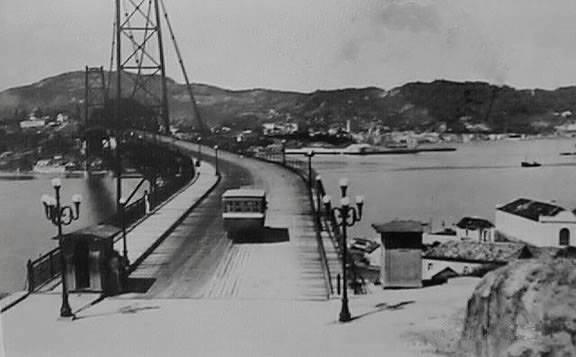
The viaducts and the central span were designed to handle the traffic of a railroad running on just two tracks positioned in the center of the bridge.
Until 1935, a toll was charged, even for pedestrians.
The wooden paving accompanied the bridge for many years.
However, it was eventually replaced by asphalt because it had some problems: the surface vibrated excessively, causing noise when vehicles passed, and it was also very slippery on rainy days.
For almost 56 years, the Hercílio Luz Bridge has been an important instrument of urban mobility in Florianópolis, but it has received little maintenance.
Reference: https://www.sc.gov.br/vivaaponte/historia-e-curiosidades/

 Português do Brasil
  English