

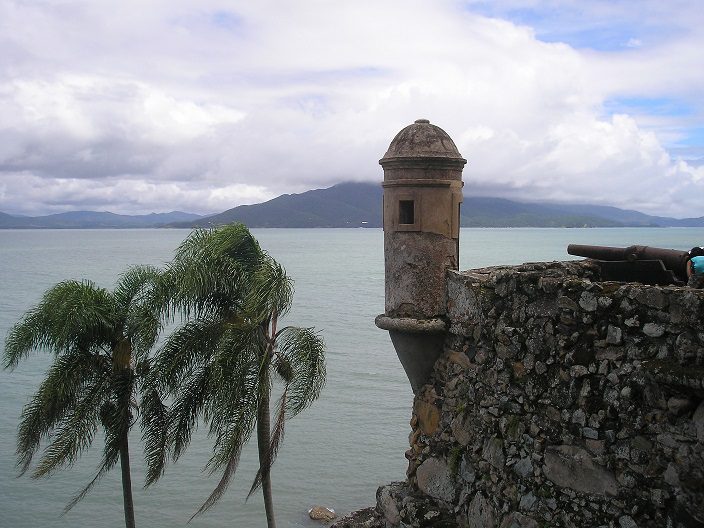
Conceived by Brigadier José da Silva Paes, a Portuguese military engineer and the first governor of the Captaincy of Santa Catarina, the Defensive System of the Island, now the city of Florianópolis, involving fortresses, was begun in 1739 and took around ten years to complete.
Portugal sent Silva Paes as governor to protect the region from the Spanish invasion, but when he arrived, he identified the need to build fortresses.

The complex is currently on a shortlist submitted to Unesco to become a World Heritage Site.
The structure built by the Portuguese to protect the beauty of Santa Catarina Island had dozens of fortifications, the most significant being the Anhatomirim, Ponta Grossa and Ratones fortresses in the North Bay and the Araçatuba Fortress in Barra Sul.
Set of Fortresses
The first to be built was the Santa Cruz Fortress, on Anhatomirim Island, followed by the São José da Ponta Grossa Fortress, next to Jurerê.
Then Santo Antônio, on Ratones Grande Island, in the North Bay.
Lastly, at the southern end of Santa Catarina Island, is the Fortress of Nossa Senhora da Conceição, on Araçatuba Island.

Defensive Vertex with Fortresses
The fortresses in the north of the island, Anhatomirim, Ponta Grossa and Ratones, were strategically designed to form a defensive apex.
Paes' idea was to cross the cannon fire and protect the bay from invading Spanish ships.
In addition, a fourth fortress was built on Araçatuba Island to face attacks from the south.
The most striking feature is the circular battery of cannons. It's one of the few in the world.
In fact, when you look from above, you can see that the armaments were arranged in 360 degrees.
That way, from whichever side the attack came, the enemy could be fought.

Fortresses: Historical Heritage
In the 1970s, the National Historical and Artistic Heritage Institute (IPHAN) carried out the first restoration work on the Santa Cruz de Anhatomirim Fortress.
In 1979, the rediscovery of the fortifications as cultural heritage of Santa Catarina and Brazil became intertwined with the history of the Federal University of Santa Catarina - UFSC - when it took over the care and maintenance of Anhatomirim.
However, from 1989 onwards, UFSC created and coordinated - together with IPHAN and the support of the Navy and other partner organizations - the Santa Catarina Island Fortresses Project, It also started managing the fortresses of Ratones and Ponta Grossa, which were restored by the initiative.

Historical rescue of the fortresses
The process of historical recovery is currently involved in research, documentation, conservation, dissemination and appreciation of Santa Catarina's fortifications.
Thus democratizing access to knowledge and helping to optimize the educational, cultural and tourist potential of these national monuments.
Open to the public, the fortresses are a hub of knowledge and culture, being one of the best preserved military architecture complexes in Brazil.
In addition to the best known and most visited forts, many others also existed on the island of Santa Catarina. Check it out here.

Check out more information by clicking on the magnifying glass in this table: https://fortalezas.org/index.php?ct=artigo&id_artigo=101

 Português do Brasil
  English